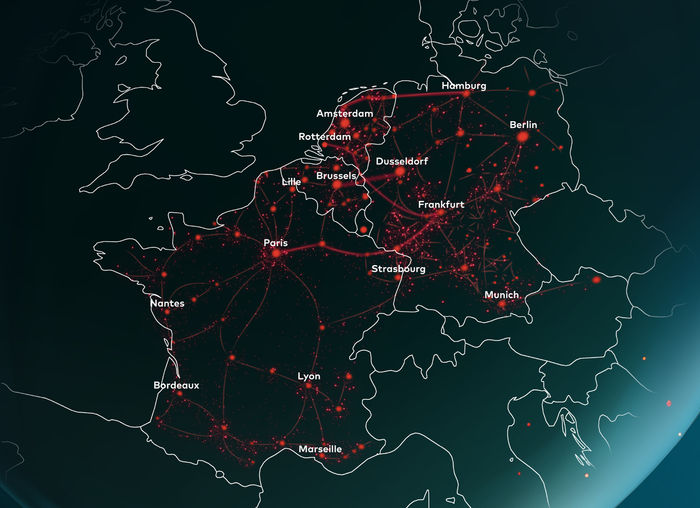
DC-to-DC connectivity

The growth of AI, cloud computing, and data traffic is radically transforming Europe’s digital infrastructure. Data centers are increasingly operating as part of a single interconnected ecosystem, in which data and workloads are continuously exchanged between locations. As a result, Data Center to Data Center connectivity is becoming increasingly important. It forms the foundation for the performance, scalability, and reliability of modern digital services.
Three trends driving the demand for DC-to-DC connectivity
1. Data center growth is shifting to new locations
Traditional hubs such as Amsterdam, Frankfurt, and Paris remain important, but expansion is increasingly limited by available space and energy. New data centers are therefore emerging in Tier 2 and Tier 3 locations across Europe. Think of cities like Hamburg, Düsseldorf, Berlin, Lyon, and Milan. Edge data centers are also playing an increasingly significant role.
This is transforming the European data center landscape. Whereas organizations used to primarily connect large hubs to one another, a network of interconnected data centers is now emerging. All of these locations must be connected reliably and with sufficient capacity. Connecting these datacenters requires further deployment into the edges of networks.
2. AI increases the demands on networks
AI requires not only more computing power, but also high bandwidth connectivity able to cope with bursting capacity needs. As more AI capacity is added, the need for connections between data centers, cloud platforms, and GPU clusters grows. Large datasets must be able to be exchanged quickly and reliably between locations.
This translates to higher demands on capacity, latency, and scalability. Bandwidths of 100G and 400G are increasingly becoming the standard.
3. Data sovereignty is becoming more important
Demand for European cloud and connectivity solutions is rising as organizations seek greater control over their data and digital infrastructure. At the same time, the number of European cloud providers and regional digital ecosystems is growing. In this context, it is not only data center locations that are important, but also the networks that connect data centers, cloud platforms, and end users. Demand for European cloud and connectivity solutions is rising as organizations seek greater control over their data and digital infrastructure. At the same time, the number of European cloud providers and regional digital ecosystems is growing. In this context, it is not only data center locations that are important, but also the resilient networks that connect data centers, cloud platforms, and end users.
More locations, higher demands
The growth of cloud computing, AI, and regional data centers is creating new challenges. Organizations need:
- More connected locations
- Direct connections to (European) cloud provider
- Higher capacity
- Low latency
- Route diversity
- High availability
This is no longer just about connecting two data centers. It’s about creating a scalable European data center ecosystem in which workloads can move flexibly between locations.
This requires long-distance connections designed for high performance over hundreds of kilometers. Connections capable of handling large volumes of data without compromising on latency or reliability.
Why Network Ownership Matters
As connectivity becomes increasingly business-critical, the importance of the party behind the network also grows. Many long-haul connections are provided through multiple suppliers and infrastructures. When a single party owns the entire route, it gains greater control over resilience, performance, maintenance, and incident management. This offers benefits such as:
- Faster recovery processes
- Full visibility into the path
- Predictable maintenance
- Reliable SLAs
- Shorter lines of communication during incidents
- Digital resilience through route diversity, network redundancy and full control over the underlying infrastructure
This is becoming increasingly important for international data center and cloud environments.
Eurofiber’s Role
Eurofiber supports organizations with a densely meshed European fiber-optic network that connects more than 300 on-net data centers across five countries. In addition to connections between major European hubs, Eurofiber also provides access to regional and emerging data center locations in the edge of the networks. This enables organizations not only to connect existing ecosystems but also to tap into new growth regions.
The long-haul infrastructure is designed for high capacity, low latency, and reliable performance over long distances. In addition, Eurofiber offers alternative routes between major European data center regions, enabling greater route diversity and redundancy.
By using its own infrastructure, Eurofiber retains control over design, management, and service delivery. In addition, Long Haul is provided using available capacity on the network, which means new connections can often be established within a few weeks.
Discuss your requirements